birdidpv identification report
Machine identification, not a verified record: BirdNET scores each 3-second frame. It does not confirm that a species was present. Confidence is not a probability. A high score on one frame is not a record. Listen before citing any of this.
- Sources
- 260115_002_Tr1.WAV (track 1 only)
- Recordist
- Gewenxin Yu
- Recording setup
- Two Primo EM273 omni-directional microphones (−37 dB ± 3 dB at 1 kHz, 80 dB S/N ratio, 60 Hz ~ 20 kHz) and a Zoom F3 recorder
- Model
- BirdNET (Cornell Lab / Chemnitz UT) via birdnetlib, 3-second frames
- Ranges analysed
- 135 below-threshold ranges from lowdom · 00:43:30 of 03:02:24 (23.8% of the take)
- Species filter
- 29.898°N, 102.03°E · week 3 of 48 · 6,522 species reduced to 788
- Minimum confidence
- 0.25
- Detections
- 128 frames in 11 species
The pale band marks the 135 ranges lowdom left below its threshold. The rest of the take was not analysed. Each mark is one 3-second detection. Higher confidence makes the mark taller and darker.
Species
| Reference | Species | Frames | Highest | At | First heard |
|---|---|---|---|---|---|
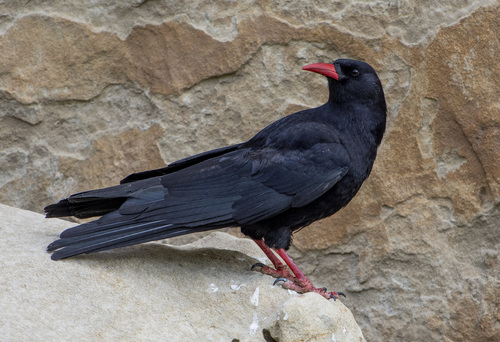 Pavel Shukov · CC-BY-NC Pavel Shukov · CC-BY-NC | Red-billed ChoughPyrrhocorax pyrrhocorax | 82 | 1.000 | 00:40:35 | 00:23:36 |
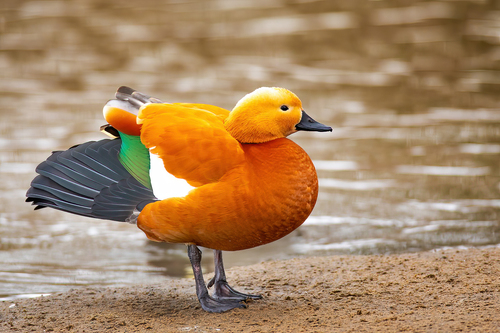 egorbirder · CC-BY egorbirder · CC-BY | Ruddy ShelduckTadorna ferrugineacheck by ear | 2 | 0.928 | 01:41:05 | 01:41:05 |
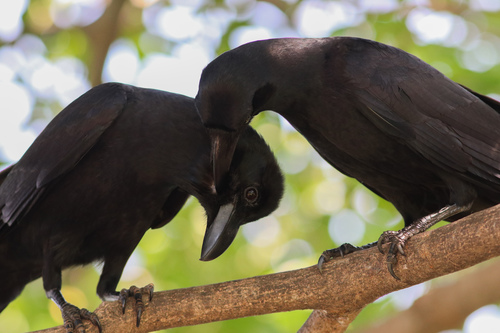 Joe Bourget · CC-BY-NC Joe Bourget · CC-BY-NC | Large-billed CrowCorvus macrorhynchos | 17 | 0.912 | 00:32:28 | 00:32:10 |
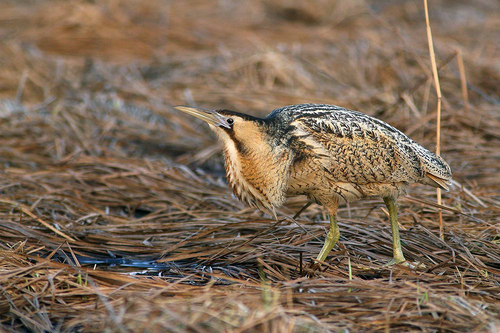 Tatyana Zarubo · CC-BY-NC Tatyana Zarubo · CC-BY-NC | Great BitternBotaurus stellarischeck by ear | 12 | 0.906 | 00:11:19 | 00:10:15 |
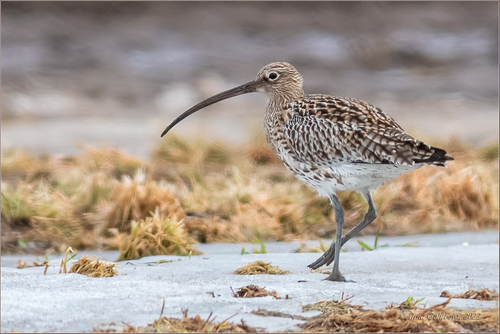 Анна Голубева · CC-BY-NC-ND Анна Голубева · CC-BY-NC-ND | Eurasian CurlewNumenius arquatacheck by ear | 1 | 0.684 | 02:52:35 | 02:52:35 |
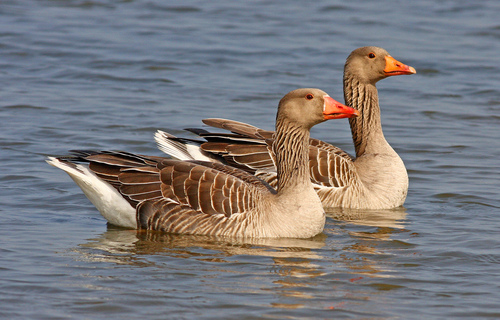 Frans Vandewalle · CC-BY-NC Frans Vandewalle · CC-BY-NC | Graylag GooseAnser ansercheck by ear | 2 | 0.628 | 00:09:33 | 00:09:33 |
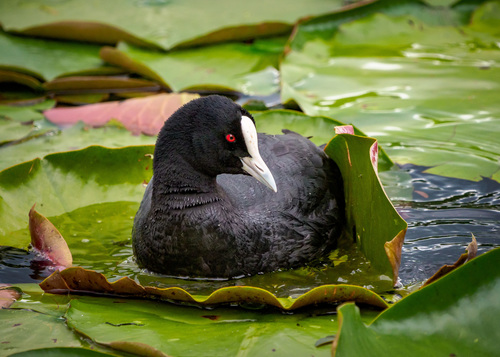 Wei Li Jiang · CC-BY-NC Wei Li Jiang · CC-BY-NC | Eurasian CootFulica atracheck by ear | 8 | 0.611 | 02:18:36 | 00:23:15 |
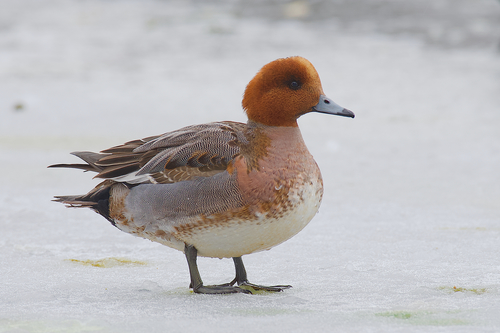 zametnya · CC-BY-NC zametnya · CC-BY-NC | Eurasian WigeonMareca penelopecheck by ear | 1 | 0.443 | 00:37:06 | 00:37:06 |
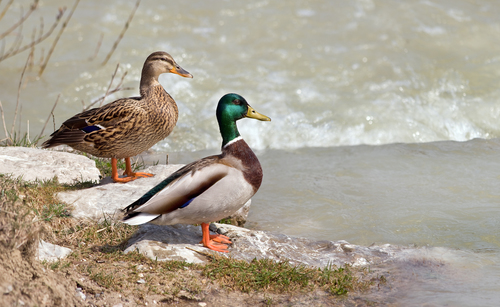 unknown photographer · CC-BY-SA unknown photographer · CC-BY-SA | MallardAnas platyrhynchoscheck by ear | 1 | 0.439 | 02:08:17 | 02:08:17 |
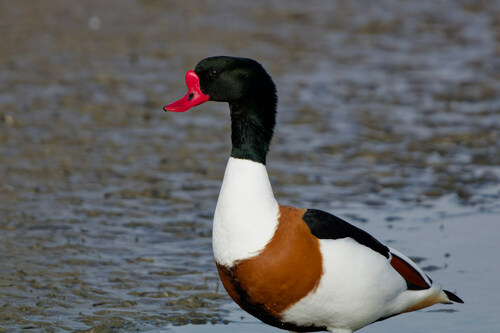 thegreatdodo · CC-BY-NC thegreatdodo · CC-BY-NC | Common ShelduckTadorna tadornacheck by ear | 1 | 0.365 | 00:24:40 | 00:24:40 |
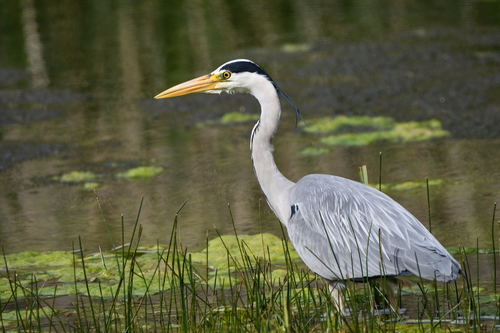 Frank Sengpiel · CC-BY Frank Sengpiel · CC-BY | Gray HeronArdea cinereacheck by ear | 1 | 0.264 | 02:37:10 | 02:37:10 |
Reference photographs come from iNaturalist. We store them in this package rather than hot-linking them. The package survives archiving that way, and no reader's address is sent to a third party. Each file is kept exactly as iNaturalist served it. It remains under its photographer's licence, credited beside it. The machine-readable record is in credits.json. A photograph shows what the species looks like. It is not evidence that the species was here. Nine of these eleven rows are flagged for manual review. One of those nine is a photograph of a bird that was never there.
Taxon identifiers
These are the same eleven species in the databases a detection usually has to travel to. We matched them on iNaturalist taxon ID, not on name. A name search returns a congener often enough. Attaching an identifier to the wrong bird is a real risk. Wikidata holds dozens more per species. We keep those in taxon-ids.json.
| Species | Elsewhere |
|---|---|
| Red-billed ChoughPyrrhocorax pyrrhocorax | Avibase eBird GBIF ITIS IUCN EOL iNaturalist Wikidata |
| Ruddy ShelduckTadorna ferruginea | Avibase eBird GBIF ITIS IUCN EOL iNaturalist Wikidata |
| Large-billed CrowCorvus macrorhynchos | Avibase eBird GBIF ITIS IUCN iNaturalist Wikidata |
| Great BitternBotaurus stellaris | Avibase eBird GBIF ITIS IUCN EOL iNaturalist Wikidata |
| Eurasian CurlewNumenius arquata | Avibase eBird GBIF ITIS IUCN EOL iNaturalist Wikidata |
| Graylag GooseAnser anser | Avibase eBird GBIF ITIS IUCN EOL iNaturalist Wikidata |
| Eurasian CootFulica atra | Avibase eBird GBIF ITIS IUCN iNaturalist Wikidata |
| Eurasian WigeonMareca penelope | Avibase eBird GBIF ITIS IUCN EOL iNaturalist Wikidata |
| MallardAnas platyrhynchos | Avibase eBird GBIF ITIS IUCN EOL iNaturalist Wikidata |
| Common ShelduckTadorna tadorna | Avibase eBird GBIF ITIS IUCN EOL iNaturalist Wikidata |
| Gray HeronArdea cinerea | Avibase eBird GBIF ITIS IUCN iNaturalist Wikidata |
Reading this against a frozen lake
Two corvids make up 99 of the 128 detections, and both match the audio clearly. They carry energy well above 2 kHz, and they sit 3–11 dB above everything else. The other nine species share 29 frames, and all of them are deep-voiced waterbirds. The lake had frozen over by mid-January at 4,055 m, and we measured the detected frames after a 150 Hz high-pass, so that measurement shows where the two groups part:
| Detected as | 150–400 Hz | 400 Hz–2 kHz | 2–8 kHz | Level |
|---|---|---|---|---|
| Red-billed Chough | 24% | 55% | 21% | −44.3 dBFS |
| Large-billed Crow | 14% | 85% | 1% | −41.2 dBFS |
| Great Bittern | 45% | 49% | 5% | −51.8 dBFS |
| Ruddy Shelduck | 52% | 45% | 3% | −47.2 dBFS |
| Eurasian Coot | 89% | 10% | 1% | −48.3 dBFS |
The waterbird detections concentrate their energy below 400 Hz at a lower level, and they mostly show none of the high-frequency structure the corvid detections do. That band is where the ice resonance sits, and local guides call that sound long hou, “dragon roar”. BirdNET often maps ice onto birds whose calls are booms, and Great Bittern at 0.906 is the strongest false positive. Its twelve detections arrive in sustained runs, and eight of them fall inside seventy seconds, but not one of their spectrograms shows a call above the ice.
Compare the recordings to understand the mistake. On the first page of xeno-canto recordings for Botaurus stellaris, try XC891071, XC1000766, XC832807 and XC741523. The booms sound similar to the dragon roar, so listen to them here, and then listen to any green stretch of the timeline above:
-
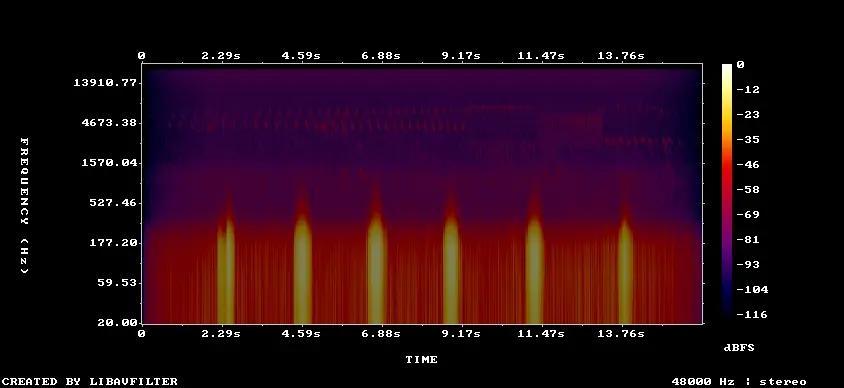 XC891071 · player · Christian Bøggild · Denmark · CC BY-NC-SA
-
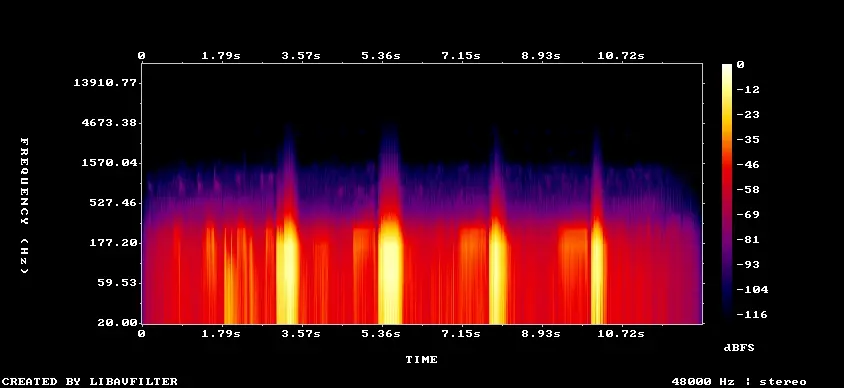 XC1000766 · player · Christian Bøggild · Denmark · CC BY-NC-SA
-
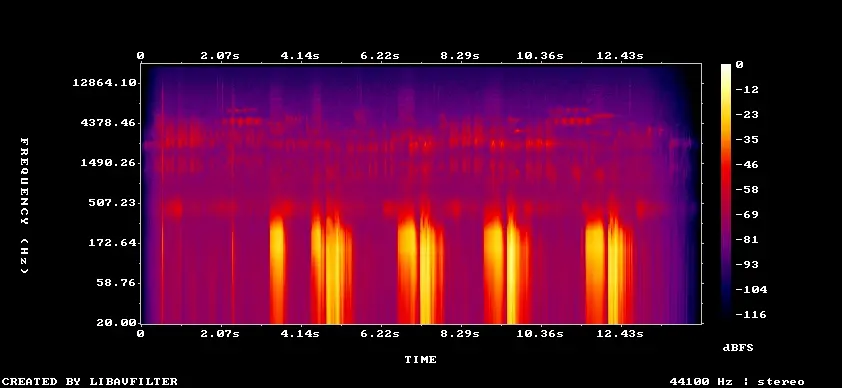 XC832807 · player · Cedric Mroczko · Ukraine · CC BY-NC-SA
-
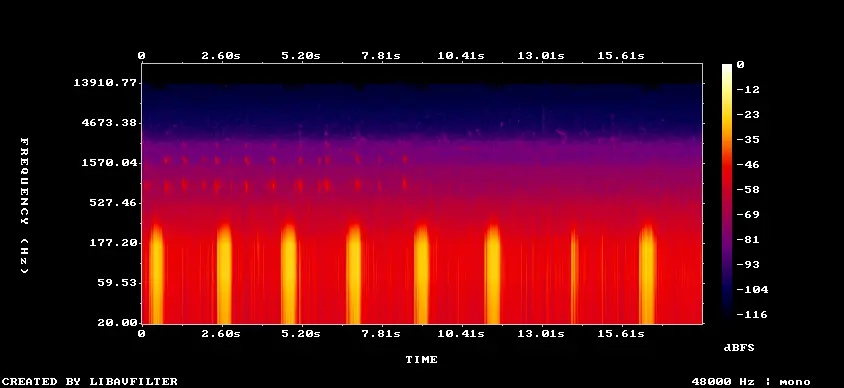 XC741523 · player · Romuald Mikusek · Poland · CC BY-NC-SA
These recordings are stored in this package under their recordists' CC BY-NC-SA licences. We do not embed them from xeno-canto. The comparison survives archiving that way, and no reader's address is sent to a third party. We re-render the spectrograms here with the same axes and scaling as the detection frames above. xeno-canto draws its own spectrograms on a linear frequency axis. That axis suits the wide scrubbing strip in its player. It also leaves the boom as a thin line along the bottom while the background birds fill the frame. Put next to a detection from this take, the same sound would look like a different one.
In listening tests, the ice carries an electronic quality that the bird does not, and that difference is audible, but none of the spectrogram statistics on this page captured it.
The frame at 01:41:05 is also not a bird. BirdNET calls it Ruddy Shelduck at 0.928, which is the second highest confidence in the whole run, but there is no bird in it. It is Xiao Zhang, one of the guides, calling across the lake to the recordist, who identified it on listening.
Open that frame when reviewing the report, because it also shows how a spectrogram can be misread. It carries harmonic stacks between 1 and 3 kHz, and we first took them for a call, but ice does not produce structure like that. We moved the species out of the doubtful list, and a voice does produce it: a pitch contour gliding through its harmonics, formants around 1.2 and 2 kHz, four or five syllables in the last second. That is speech, not song. The band average in the table above had hidden the voice under the low-frequency bed, and the picture that corrected the first reading was then read incorrectly, so listening was required to resolve it.
The detections fall into three groups: confirmed calls, lake ice, and at least one human voice. Every row marked check by ear should be checked against the source WAV before citation, and the frame at 01:41:05 is the main reason: the model's second most confident bird in three hours was a person calling across the lake.
Open the multimedia report Open the bare CLI multimedia report Open the bare CLI timeline report Open the lowdom screening report Download every detection Download the species roll-up Download the taxon identifiers Read the summary
 Open the multimedia report
 Open the bare CLI multimedia report
 Download every detection
 Download the taxon identifiers
Identification by BirdNET, developed by the K. Lisa Yang Center for Conservation Bioacoustics at the Cornell Lab of Ornithology with Chemnitz University of Technology, reached through birdnetlib. The BirdNET models are licensed CC BY-NC-SA 4.0 and that non-commercial condition applies to these results. Cite: Kahl, S., Wood, C. M., Eibl, M., & Klinck, H. (2021). BirdNET: A deep learning solution for avian diversity monitoring. Ecological Informatics, 61, 101236. Neither this report nor field-audio-tools is affiliated with or endorsed by the BirdNET team.